
You glance at the sticker on the boiler, do the mental arithmetic, and look away again. Two years. Possibly three. You meant to sort it before last winter and then didn’t, and now here you are again in October with the same intention and the same mild unease about what’s actually going on in there.
Most boiler service reminders get treated like dental appointments — important in theory, easy to push back another month.
What you’re actually getting when you book a service
The comparison to a car MOT gets used a lot. An MOT confirms the car is currently roadworthy. A boiler service is meant to catch what’s wearing out before it fails — not just check that today it’s still going. That’s a meaningfully different job, done differently by different engineers.
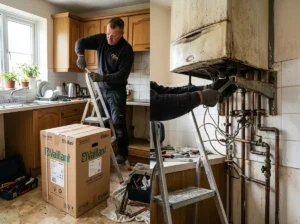
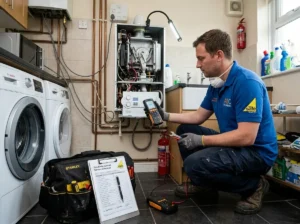
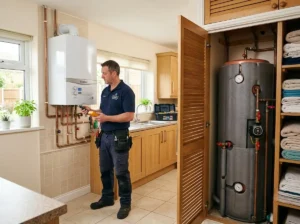
A proper service involves the engineer opening the casing, checking the heat exchanger for fouling and cracking, testing the burner for correct flame pattern, running a combustion analysis through the flue to check that the gas is burning cleanly and the products are leaving the building correctly. They should check the condensate trap and pipe, the pressure relief valve, the expansion vessel charge, and the electrodes. On hard water areas like Cheshunt, Enfield and Waltham Cross, a thorough engineer also checks for scale on the heat exchanger surfaces — because Thames Water will have been working on it since the last service.
The whole process takes 45 to 60 minutes done properly. If the engineer was in and out in 20 minutes, something was skipped. That’s not always obvious in the moment — the boiler fires up, the engineer hands back the paperwork, everyone’s satisfied. The missed checks show up twelve months later as a fault code, or they don’t show up at all until you’re asking about carbon monoxide.
The service record problem when you’ve moved house
A lot of homeowners inherit a boiler with no service history. The solicitor’s pack had no documentation, the previous owner waved vaguely at the boiler and said it was fine, and now you’ve been in the house a year and still haven’t got anyone to look at it.
This is worth sorting earlier than most people do. A boiler with no service record isn’t necessarily dangerous, but there’s no way to know what’s already been noticed and not acted on. You don’t know whether the heat exchanger has been cleaned in five years, or whether a previous engineer left an advisory note about flue seals that nobody followed up. Treating that first visit as a proper condition check rather than a quick annual tick is the sensible approach.
JTS covers boiler servicing in Cheshunt, Waltham Cross, Enfield, Harlow and surrounding Hertfordshire postcodes. Local engineers in this area deal with hard water systems regularly — it shapes what they’re looking for when they open the casing.
When a service tells you the boiler needs replacing instead
Most service callouts are routine. A small percentage of them turn into a different conversation. An engineer who opens the casing and finds a cracked heat exchanger, carbon contamination on the burner, or a flue seal that’s failing isn’t going to be able to sign off the service record as satisfactory.
What happens next depends on the age of the boiler and the cost of the repair. A heat exchanger on an 8-year-old mid-range boiler may cost more to replace than the boiler is worth. Parts for discontinued models can be on long lead times, or no longer available at all. The engineer should tell you this honestly rather than doing a temporary repair and leaving you to discover the same problem six months later.
A boiler replacement isn’t always where this ends up. A boiler under ten years old from a decent manufacturer, with a repair that costs a few hundred pounds, is usually worth fixing. The decision changes when the repair quote is pushing £400–£500 on a boiler that’s twelve years old and the parts are getting harder to source.
What the engineer should leave behind
Every service should produce a signed service record that goes in the boiler’s logbook or, if there isn’t one, is left with you. On newer boilers this is recorded in the Benchmark document. On older installations it may be a separate service record card.
The record matters. If you ever need to make a warranty claim, the manufacturer will ask for evidence of annual servicing. If you sell the property, your buyer’s solicitor will want the gas appliance documentation. A service that gets done but not properly recorded is one that, from a paperwork perspective, may as well not have happened.
If the engineer found anything advisory — something that doesn’t need fixing today but should be watched — that should be written down and explained. Not mentioned verbally in passing and forgotten by the time they’ve driven away.
Boiler cover plans — when they make sense and when they don’t
Monthly boiler cover from the big energy suppliers is marketed heavily each autumn. For some households it makes sense. For others it’s an expensive way to pay for something that rarely gets used, with excess charges and call-out windows that don’t suit working households.
The maths is worth doing honestly. A standalone annual service from a local Gas Safe engineer typically costs £80 to £110 in Hertfordshire. A monthly cover plan at £20 a month is £240 a year before any excess payments. The plan often includes breakdown cover, which changes the calculation — but if your boiler is less than five years old and under manufacturer warranty, breakdown cover duplicates protection you already have.
The alternative used by many homeowners is to pay for the annual service separately, keep a few hundred pounds aside for potential repairs, and call a local Gas Safe engineer when something goes wrong. No excess payments, no call centre queues, and someone who actually knows your boiler rather than reading from a job sheet.
JTS also handles central heating and gas boiler installation work alongside annual servicing. When the engineer who does your service also knows your system from a previous installation or repair, conversations about whether to fix or replace are more straightforward — there’s no incentive to push a particular outcome.
To book a boiler service in Hertfordshire, contact JTS directly.
JTS Plumbing & Heating Cheshunt, Hertfordshire 07578 172661 info@jtsplumbingandheating.com Get in touch with JTS