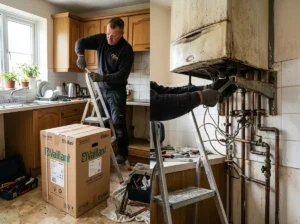
Three callouts on the same boiler in one winter, that’s usually the moment people finally ring us about a Boiler Replacement Service instead of another repair. A customer in Enfield hit that exact point in January, same fault twice, a different one the third time, and the engineer’s bill was creeping close to what a new unit would’ve cost outright.
The point where repair stops paying off
Every boiler reaches an age where fixing it becomes the more expensive habit. Past the fifteen-year mark, or once callouts start turning into a yearly thing rather than a one-off, the maths tends to flip in favour of replacing rather than repairing again. Parts get harder to source on older models too, which means longer waits and higher prices even for a simple fix. None of that means panic the moment a boiler turns ten, plenty run fine well past that, but it’s worth watching the pattern rather than just the latest fault.
What the numbers actually look like
A modern condensing boiler runs at 92 to 94 percent efficiency, well above what most units installed fifteen or twenty years ago manage. On a typical three-bed Hertfordshire house, that difference can save somewhere between £300 and £500 a year on gas. Spread across five to eight years, that gap on its own covers the installation cost, and everything after that is straightforward saving rather than money spent standing still.
Getting the installation right the first time
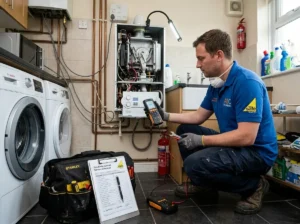
A Boiler Replacement Service isn’t just unbolting the old unit and fitting a new one. Gas Boiler Installation has to be carried out by a Gas Safe registered engineer, it’s a legal requirement in the UK, and it’s worth checking anyone’s registration on the Gas Safe Register before they touch your system. Older properties around Cheshunt and Waltham Cross often still run microbore pipework or a cylinder system that’s never been power flushed, and fitting a new boiler onto years of built-up sludge is one of the fastest ways to void a warranty from Worcester Bosch, Vaillant, or Baxi. Our boiler installation page covers what a proper survey checks before any work starts.
Don’t stop at just the boiler
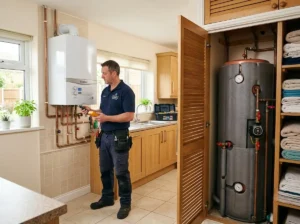
Replacing the boiler on its own sometimes just moves the problem rather than solving it. If radiators run cold at the bottom or pipework’s original to the house, Central Heating Installation usually needs looking at alongside the boiler rather than being left for another year. Our central heating services page covers what’s involved when both are done together, and doing both at once tends to work out cheaper than fixing the system in pieces over time.
Keeping the new system running well
Once the new boiler’s in, Boiler Servicing and Maintenance is what keeps it that way. An annual check picks up small issues, faint noises, pressure creeping down, before they become a breakdown, and most manufacturers make it a condition of the warranty anyway. Skipping it is the quickest way to end up back at square one within a few years of a brand-new install.
Final thoughts
Most people wait for a boiler to fail completely before considering replacement, when the better moment is usually a year or two before that point. Watching the pattern of repairs, rather than reacting to the latest one, tends to save both money and a cold week in winter.
JTS Plumbing & Heating has covered Cheshunt, Waltham Cross, and the wider Hertfordshire area for over a decade, with a proper survey the right starting point before any Boiler Replacement Service. Call direct on 01992 413953.
FAQs
How do I know if I need a full boiler replacement?
Repeated callouts within the same year, a boiler past fifteen years old, or rising repair costs are the clearest signs it’s time.
Is a boiler replacement always more expensive than repair?
Upfront, yes, but repeated repairs on an ageing boiler often cost more over a couple of years than one replacement.
Do I need to replace the whole heating system at the same time?
Not always, but if radiators or pipework are original to the house, doing both together usually costs less overall.
How often should a new boiler be serviced?
Once a year, which most manufacturers require to keep the warranty valid.