
Cold house. You’ve patched it along for another season — turned up the electric heater, put another jumper on, told yourself you’d sort the heating properly in spring. Spring came. You didn’t. Now it’s October again and you’re back in the same position.
Most people put off central heating installation for years. Not because of the cost — that’s usually the reason they give — but because they picture engineers in the house all week, floorboards lifted, dust everywhere. Planned properly, an installation in a standard Hertfordshire semi runs three to four days and leaves less mess than most bathroom refits.
The old system problem that nobody mentions in the cost guides
Every online cost guide will tell you what central heating installation costs in a three-bedroom semi. None of them tell you what it costs in a 1970s terraced house in Cheshunt that still has microbore copper pipework, a gravity-fed hot water cylinder in the airing cupboard, and radiators that haven’t been balanced since 2003.
Older properties in Hertfordshire — and across the Enfield, Waltham Cross, and Harlow belt — very often have one of these situations. Microbore pipework runs at 8mm or 10mm diameter rather than the 15mm standard, and while a new combi boiler can technically work with it, the flow rate is restricted enough that rooms at the end of the circuit heat slowly or not at all. A competent engineer will spot this during the survey and either recommend upsizing the pipe runs on problem circuits or adjusting the system design accordingly. An engineer who misses this will install the boiler and leave you with a back bedroom that never quite warms up and no clear explanation why.
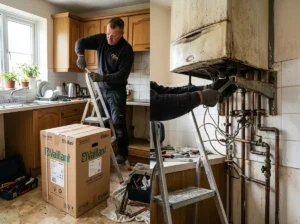
The other thing cost guides skip is sludge. A system that’s been running for fifteen or twenty years without inhibitor treatment builds up magnetite and rust debris in the pipework and radiators. Fit a new boiler to a sludged system and that debris circulates through the new heat exchanger. Worcester Bosch, Vaillant, Baxi — every major manufacturer states clearly that a power flush is required before installation if the existing system carries significant debris, and that warranty claims can be rejected if this hasn’t been done.
JTS Plumbing & Heating carries out a system assessment before any central heating installation to identify these issues before work starts.
Combi or system — the question that actually matters for your house
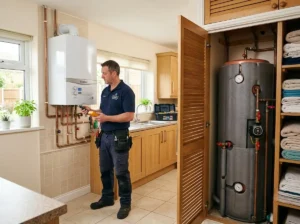
Most households in Hertfordshire end up with a combi, and for a lot of them that’s the right call. No cylinder taking up the airing cupboard, no tank sitting in the loft, instant hot water when you need it. For a two or three-bedroom house with one bathroom, the combi argument is usually straightforward.
The four-bedroom house with two bathrooms and an en-suite is where it gets more complicated. Running a shower, a bath, and the kitchen tap off a combi at the same time — the system can’t always keep up, particularly if mains pressure into the house is already on the low side. A system boiler with an unvented cylinder handles multiple outlets without the same pressure drop because the hot water is stored ready rather than heated on demand.
Nobody on a comparison website will tell you which applies to your house because they haven’t seen your house. An engineer who visits, checks mains pressure, counts the hot water outlets, and asks how many people use the bathrooms at the same time can actually give you that answer. That visit is how gas boiler installation quotes from JTS are put together.
Why “it’s still working” isn’t a good reason to keep the old boiler
A G-rated boiler from 2005 that’s still going will cost noticeably more to run each winter than a modern replacement. Old non-condensing boilers sit around 70% efficiency. A current condensing boiler runs at 92–94%. That gap translates into real gas spend — for a typical three-bedroom Hertfordshire house, often somewhere between £300 and £500 a year, more if the property isn’t well insulated.
That figure repays the installation cost in five to eight years, after which the savings are ongoing. And that calculation doesn’t account for the repair costs that tend to cluster in ageing boilers — heat exchanger failures, pressure vessel issues, parts that are no longer stocked. At a certain point an old boiler costs more in callouts than its replacement would have.
The time to think seriously about replacement is usually around the fifteen-year mark, or when repair bills start arriving annually. Not when it finally stops working entirely on a Friday evening in January. Emergency replacements are slower to arrange, offer less choice of boiler, and cost more.
Gas Safe — what it actually means and why it matters here
Gas Safe registration is a legal requirement in the UK for any engineer working on gas appliances. Not a quality mark — a legal requirement. Unregistered gas work has caused deaths in the UK. Carbon monoxide leaks from badly fitted boilers, gas leaks from poorly connected pipework. It’s not theoretical.
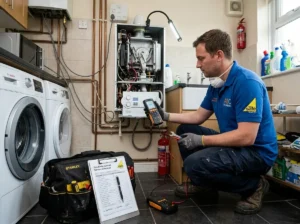
Every engineer who works on your system must be on the Gas Safe Register and carry their card. The card lists the categories of gas work they’re qualified for — not all Gas Safe engineers are qualified for every type of installation. Checking the register at gassaferegister.co.uk takes two minutes.
JTS Plumbing & Heating engineers are Gas Safe registered. It’s worth knowing before you let anyone start work, regardless of who you use.
When to book and what happens on the day
Summer is genuinely the better time to book central heating installation if you have the option. Engineers have more availability, parts lead times are shorter, and your family isn’t living without heating in cold weather while the work is in progress. September and October bookings fill up faster than most homeowners expect.
The installation runs three to five days depending on property size and how much pipework needs replacing. Radiator positions and pipe runs go in first. The boiler gets fitted once the system holds pressure. At the end there’s a commissioning visit — the system gets balanced, the programmer set, the controls explained.
After the first winter most people are surprised by the gas bill. Usually in a good way. And usually a bit annoyed it took them this long.
To arrange a survey or ask about gas boiler installation in Hertfordshire, get in touch with JTS directly.
JTS Plumbing & Heating Cheshunt, Hertfordshire +44 7578 172661 info@jtsplumbingandheating.com Contact JTS Plumbing & Heating